
This page provides detailed procedure or method statement for the installation of refrigerant piping, we have included necessary tools requirements and the procedure of refrigerant method statement for installation and testing of copper pipes.
Project manager is overall responsible for implementation of this method statement and relevant quality, health and safety requirements.
Before starting the refrigerant piping works arrange below tools & equipment.
Tool Boxes
Sandpaper or Sand cloth
Wire brush
Testing Tools
Nitrogen cylinder
Soldering Tools
Razor
Measuring Tape
Hand Drilling Machine
Ladders / Scaffolding.
Additionally safety requirements tools such as safety shoes, safety helmet, safety glasses, fluorescent vest, safety gloves and masks shall be arranged in order to ensure safe work environment.
HSE Requirements
Ensure all concerned personnel shall use PPE (Personal Protective Equipment) and all other items as required.
Make sure adequate lighting is provided in the working area especially when working in night time.
Ensure service area/work area openings are provided with barricade, tape, and safety nets.
Material Handling and Storage
On receipt of the refrigerant pipes and accessories at site, necessary precautions shall be taken for unloading, shifting, and storage as follows:
All refrigerant pipes and its accessories shall be inspected, handled and stored properly upon receipt at site.
Materials shall be stored in a place free of water / dust and adequately covered to avoid any kind of weather damages.
All insulation materials shall be inspected for the thickness and densities as per approved material submittals and project specifications.
While unloading, shifting and storage, it should be ensured that there are no transit damages.
Any discrepancies or damage found to the materials will be notified and reported to QA/QC Engineer and Project Engineer for further action.
Materials found not suitable for site use should be removed from site immediately.
All materials to be used shall be as per relevant approvals.
Installation of Copper Tube and its accessories
All refrigerant pipework shall be as installed per manufacturer’s recommendations, refer to the attached manufacturer recommendation for the installation of the copper tube and solder joints.
Install piping as short and direct as possible, with a minimum number of joints, elbows, and fittings.
Piping must be installed parallel to the building lines unless otherwise noted / allowed.
All the pipe must be cut accurately to measurements established at the construction site and must be worked into place without springing or forcing.
Pipes must be installed as to permit free expansion and contraction without damage to joints or hangers.
All due consideration and allowances shall be taken to keep pipework clean and dry during the installation works.
Ensure that all pipework unfinished ends are capped off at all times.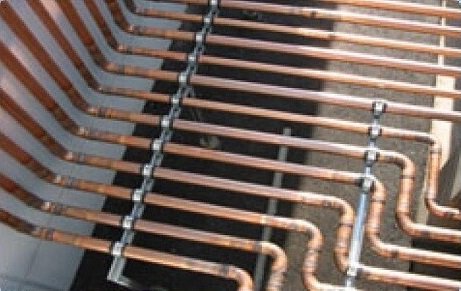
Arrange piping in a way that allows easy inspection and service of compressor and other equipment’s.
Install valves and specialties in accessible locations to allow easy service and inspection.
Installed piping must not interfere with the operation or accessibility of doors or windows and must not encroach on aisles, passageways, and equipment.
Pipe work to be properly fixed and supported using a recognized and approved support system.
Install the gauges as located in the approved shop drawings.
Pressure gauges must be installed to sense compressor suction and discharge pressures as per standard requirements.
Pipe work shall be suitably identified and labelled where specified.
Connection between piping of steel and copper of brass shall be made using dielectric fittings.
Connection between piping – sight glass, valves to be considered.
U-Trap location to be identified as per manufacturer recommendations.
Testing of Refrigerant Pipes
All completed systems will be, strength and leak tested with dry nitrogen as per Manufacturer’s recommendation. If the system is found to be leak free, the final pressure readings for both strength and leak testing are to be witnessed and recorded on given formats.
HVAC contractor must perform the leak test before insulating the pipes.
Pressure Testing procedure
The high side and low side of each completed refrigeration piping system must be pressure tested at a pressure not less than the system pressure or as per the setting of the pressure-relief device protecting the high side or low side of the system as per approved specifications and manufacturer recommendations.
The testing media must be dry nitrogen.
Isolate the compressor from the leak test by firmly closing the suction and discharge valves.
Where pressure-relief valves are installed, position the three-way dual shutoff valves so that full test pressure is applied to both relief valves.
Testing medium – Nitrogen
Do not attempt to repair any leak while the system is pressurized.
If any leaks are found, relieve the test pressure and perform repairs.
The piping will be checked with soap and water solution.
Pressure will be held for a period of 24 hours.
If there is no visible loss of pressure after 24 hours, the line will be deemed to be gas tight.
In case a pressure gauge indicates the pressure drop, the testing operations connection and shut-off valve be first rechecked for leak and tightened as necessary.
If a pressure drop is still evident, then all joints and lastly the piping itself will be checked with soap and water solution.
Recharge the system, as previously described, and allow it to remain under pressure for 24 hours, maximum pressure at least 1.5 times the operating pressure.
Once pressure is maintained raise work inspection request for approval from consultant witnessing the Installation and Leak Testing for Refrigerant Copper Pipework.
Insulation of the Refrigerant pipes:
Refrigerant pipework shall be insulated with closed cell synthetic rubber foam insulation, 25mm thick and finished as described for refrigerant pipes as per manufacturer recommendation.
Insulation shall also be presented for consultant approval.
Discover more from Project Management 123
Subscribe to get the latest posts sent to your email.