
The purpose of this Method Statement is to establish a systematic procedure for the safe handling, installation, inspection, testing, and commissioning of Low Voltage (LV) Switchboards, Motor Control Centers (MCCs), Capacitor Banks, Variable Frequency Drives (VFDs), Sub Main Distribution Boards (SMDBs), and Distribution Boards (DBs).
This document ensures that all installation activities are executed in accordance with approved shop drawings, project specifications, manufacturer recommendations, local authority regulations, and applicable international standards while maintaining the highest levels of quality and safety.
This method statement covers all activities associated with the receipt, storage, handling, installation, cable termination, earthing, inspection, testing, and pre-commissioning of:
- LV Main Switchboards
- Motor Control Centers (MCCs)
- Automatic Power Factor Correction (APFC) Capacitor Banks
- Variable Frequency Drives (VFDs)
- Sub Main Distribution Boards (SMDBs)
- Final Distribution Boards (DBs)
The procedure applies to all electrical rooms, plant rooms, utility areas, substations, and associated locations within the project.
REFERENCES
The installation shall be carried out in accordance with the latest editions of:
- Approved Shop Drawings
- Approved Material Submittals
- Project Specifications
- Manufacturer Installation Manuals
- IEC Standards
- Local Electrical Authority Regulations
- Project Quality Plan
- Approved Inspection and Test Plan (ITP)
- Project Health and Safety Requirements
ROLES AND RESPONSIBILITIES
Project Manager
- Overall responsibility for execution of works.
- Ensure adequate manpower, equipment, and resources are available.
Electrical Site Engineer
- Supervise installation activities.
- Verify compliance with approved drawings and specifications.
- Coordinate with QA/QC and Safety Departments.
QA/QC Engineer
- Conduct inspections and ensure quality compliance.
- Verify installation against approved checklists and ITP requirements.
HSE Officer
- Monitor safety compliance.
- Conduct toolbox talks and safety inspections.
Electrical Supervisors / Foremen
- Direct workforce activities.
- Ensure work is executed according to approved procedures.
Electricians and Technicians
- Carry out installation, termination, and testing activities under supervision.
TOOLS AND EQUIPMENT
The following tools and equipment shall be available and maintained in good working condition:
- Mobile Crane (as required)
- Forklift
- Pallet Truck
- Chain Block
- Hydraulic Trolley
- Portable Drilling Machine
- Grinding Machine
- Angle Cutter
- Spirit Level
- Laser Level
- Measuring Tape
- Alignment String Line
- Hydraulic Crimping Tool
- Torque Wrench
- Insulation Resistance Tester (500V / 1000V)
- Digital Multimeter
- Earth Resistance Tester
- Cable Pulling Equipment
- Hand Tools Set
- PPE and Safety Equipment
MATERIALS
LV Switchboards, MCC’s, Capacitor Banks, VFD’s, SMDB’s & DB’s and accessories shall be in line with the approved material submittal and approved drawing by local authority as per rules and standard. All materials shall be approved prior to installation and shall include:
- LV Switchboards
- MCC Panels
- Capacitor Banks
- VFD Panels
- SMDBs
- Distribution Boards
- Cable Glands
- Copper Lugs
- Earthing Conductors
- Flexible Earth Bonds
- Identification Labels
- Fasteners and Anchoring Accessories
- Fire Stop Sealants
All materials shall comply with approved material submittals and project specifications.
HANDLING AND STORAGE
On receipt of the LV Switchboards, MCC’s, Capacitor Banks, VFD’s, SMDB’s & DB’s and accessories at site, necessary precautions shall be taken for unloading, shifting & storage, as follows:-
Material shall be stored in a covered / dry space at all the time.
All materials received at site shall be inspected and ensured that the materials are as per approved material submittal.
Any discrepancies, damage etc., found will be notified and reported for further action suitably and in case if the repairs could not be done properly, the panel boards are to be sent to assembler for rectification, after all formalities carried on.
Delivery Inspection
Upon arrival at site:
- Verify quantities against delivery documents.
- Check for transportation damage.
- Confirm equipment ratings and model numbers.
- Inspect accessories and loose items.
Storage Requirements
- Store equipment in dry and weather-protected areas.
- Maintain manufacturer-recommended environmental conditions.
- Protect panels from dust, moisture, vibration, and direct sunlight.
- Keep equipment elevated above floor level where necessary.
Damage Control
Any damaged equipment shall be:
- Tagged and isolated.
- Reported immediately to the Site Engineer.
- Repaired only with manufacturer approval.
- Replaced if damage affects functionality or safety.
PRE-INSTALLATION REQUIREMENTS
Ensure that the work area is ready and safe to start the installation of LV Switchboards, MCC’s, Capacitor Banks, VFD’s, SMDB’s & DB’s.
Make sure that installation of LV Switchboards, MCC’s, Capacitor Banks, VFD’s, SMDB’s & DB’s are carried out in accordance with manufacturer’s installation recommendations, requirement of applicable standards and in accordance with recognized industrial practices and specified in project specification to ensure that installation complies with requirements.
Prior to start the installation, refer to the approved shop drawings related to the area of installation and ensure that required materials are available at site as per approved material submittals.
Ensure the materials were stored properly and there is no mark of damage or deformity of any kind before issuing the material from site store. All materials and accessories should also be free of dust, scale, or oil.
Ensure that the issued materials are of approved specifications / submittals and as per the the requirement of the area shop drawing’s. (i.e. Make, size, Model / Type etc.,).
Before commencing installation, ensure:
- Latest approved shop drawings are available.
- Material approvals have been obtained.
- Civil works and room finishes are complete.
- Equipment foundations and plinths are completed.
- Access routes for equipment movement are clear.
- Adequate lighting and ventilation are available.
- Work permits are approved.
- Safety measures are implemented.
INSTALLATION PROCEDURE FOR LV SWITCHBOARDS, MCCs, CAPACITOR BANKS AND VFDs
Ensure the floor surface is ready with base frames grouted to install the switch gear. Minimum clearance of 750 mm (as per regulation) shall be maintained at rear side of the panel so that easy access for termination of cables and other maintenance works can be carried out.
Switchboards shall be installed serially and with Level Verticality in accordance with the Manufacturer’s recommendations, approved site layout and as per site requirement.
Check cabinet interconnections, bus bar connections, control wire connections between the cubicles after proper alignment of the sections cubical as per manufacturer’s drawing and approved shop drawing.
All knockouts made on the panel covers shall be filed and provided with grommets to avoid sharp edges and unused knockouts shall be covered.
Connection of Bus bar Trunking with all panel boards shall be done rigidly with proper supports.
Cables bending radius should not be less than the 8 times of the Cable diameter in line with the Manufacturer’s recommendation.
Appropriate tools & tackles such as Rollers, Pull Cords etc., to be utilized, while cable pulling operations including Pulling winch for longer lengths.
Termination of Cables shall be done using approved cable glands and lugs.
Cable glanding and connections should be done only by competent technicians / electricians.
All panel boards and switchgears shall be provided with proper earthing connections as per approved shop drawings.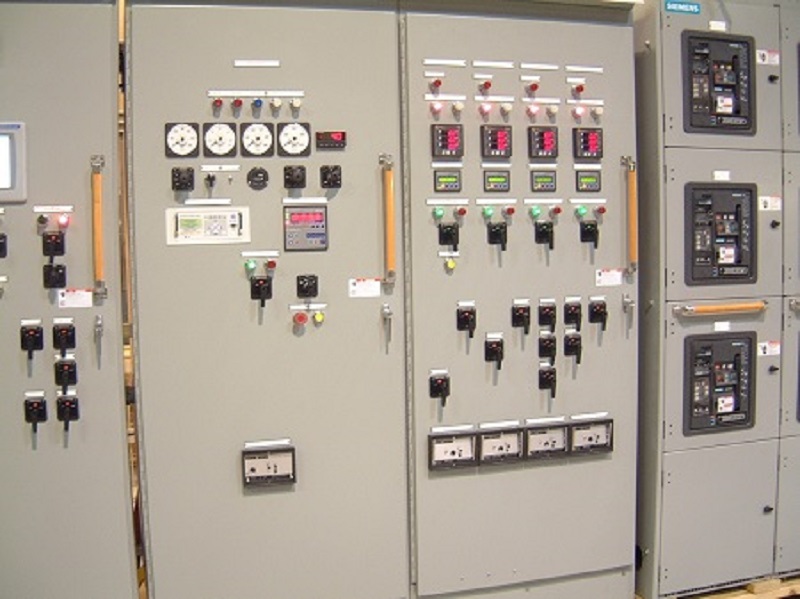
Complete wiring & terminations related to BMS shall be provided as per approved shop drawings.
Manufacturer recommendations are to be followed for all relay, timer and other breaker current settings, as per the total connected loads and the discrimination study of the system.
Identification labels of approved type shall be fixed on all panel boards.
Co-ordinate with the Main Contractor and ensure provision of Chequer plates on the open trenches inside the LV Room & Electrical rooms.
Ensure that all Cable entries and other openings of Electrical / LV Room, Wall / Floor are sealed with proper approved sealant.
Manufacture representative to verify the Site installations and provide acceptance of same prior to Energization of Panel boards after obtaining clearance from Site Engineer
Positioning and Placement
- Transport panels using suitable lifting equipment.
- Follow manufacturer lifting instructions.
- Position equipment according to approved layout drawings.
- Verify orientation before final placement.
Alignment and Leveling
- Install panels on prepared base frames.
- Ensure horizontal and vertical alignment.
- Check level using spirit or laser level.
- Secure panels using approved anchor bolts.
Assembly of Multi-Section Panels
Where panels are supplied in multiple sections:
- Align sections accurately.
- Connect busbars according to manufacturer instructions.
- Tighten all bolted connections using calibrated torque tools.
- Verify control wiring continuity between sections.
Working Clearances
Maintain minimum operational and maintenance clearances in accordance with:
- IEC requirements
- Local authority regulations
- Approved shop drawings
Recommended minimum rear clearance: 750 mm unless otherwise specified.
Cable Entry Preparation
- Remove knockouts carefully.
- Smooth sharp edges.
- Install protective grommets.
- Seal unused openings.
Busbar Trunking Connection
Where applicable:
- Install busbar trunking with approved supports.
- Verify alignment with switchboards.
- Ensure mechanical rigidity and electrical continuity.
Cable Installation and Termination
- Observe manufacturer minimum bending radius requirements.
- Use rollers and pulling devices during cable installation.
- Install approved cable glands and lugs.
- Crimp cable lugs using calibrated hydraulic tools.
- Verify phase sequence before termination.
Earthing
Provide earthing connections to:
- Switchboards
- MCCs
- Capacitor Banks
- VFDs
- Panel Frames
All earth connections shall be installed as per approved earthing drawings.
Control Wiring and BMS Interface
- Complete all control wiring.
- Terminate BMS signals as per approved schematics.
- Verify wiring continuity and identification.
Equipment Identification
Install durable labels indicating:
- Panel designation
- Incoming source
- Voltage rating
- Circuit information
- Safety warnings
Sealing of Openings
Seal all cable penetrations and wall/floor openings using approved fire-rated sealants to maintain fire compartment integrity.
INSTALLATION PROCEDURE FOR SMDBs AND DISTRIBUTION BOARDS
Installation works shall be carried out only in Accordance to approved shop drawings of latest revision.
Make sure that all civil & finishing works are completed and area is released for the area of installation and cleared by civil section to proceed on with Distribution board installations. Also ensure that the work area is clean and safe to take up activities.
Ensure the floor/ wall surface is ready to install the Distribution Boards.
Clearances are to be maintained between the SMDB’s and between the DB’s, as specified in the approved shop drawings.
Height of the Distribution Boards shall be maintained as per approved shop drawings so that easy access for termination of cables and other maintenance works can be carried out.
Connection of cable trays with all Distribution Boards shall be done rigidly with proper supports.
All knockouts made on the panel covers shall be filed and provided with grommets to avoid sharp edges and unused knockouts shall be covered. All cable entries shall be closed and sealed in a proper way.
Termination of cables shall be done using approved cable glands and lugs Glanding and connections should be done by only competent technicians electricians as per the approved
shop drawing.
All SMDB’s, DB’s shall be provided with proper earthing connections as per approved shop drawings.
Doors of all SMDB’s, DB’s are to be earthed with flexible connection.
Identification labels of approved type shall be fixed on all SMDB’s, DB’s.
Mounting
- Install boards at approved locations.
- Ensure mounting heights comply with approved drawings.
- Confirm accessibility for operation and maintenance.
Alignment
- Verify boards are plumb and level.
- Secure firmly to walls or support structures.
Cable Connections
- Connect incoming and outgoing cables according to approved schedules.
- Provide proper mechanical support for cables.
- Maintain cable segregation requirements.
Cable Entry Protection
- Fit grommets and gland plates.
- Seal all unused openings.
Earthing
- Connect body earth and neutral earth as required.
- Bond panel doors using flexible earth straps.
Circuit Identification
Install approved circuit directories and identification labels for all outgoing circuits.
QUALITY CONTROL REQUIREMENTS
The following checks shall be carried out:
- Verification of panel location.
- Equipment alignment and leveling.
- Tightness of mechanical connections.
- Busbar connection inspection.
- Cable gland inspection.
- Cable termination verification.
- Earthing continuity verification.
- Labeling verification.
- Fire stopping inspection.
All inspections shall be recorded on approved inspection forms.
TESTING AND PRE-COMMISSIONING
Prior to energization, perform:
Visual Inspection
- Check mechanical condition.
- Verify cleanliness.
- Confirm all covers are secured.
Electrical Testing
- Insulation Resistance Test
- Earth Continuity Test
- Phase Verification
- Torque Verification
- Functional Testing of Controls
- Protection Relay Verification
- VFD Functional Checks
- Capacitor Bank Operation Verification
Manufacturer Inspection
Where required, the manufacturer’s representative shall inspect and certify the installation prior to energization.
HEALTH, SAFETY AND ENVIRONMENTAL REQUIREMENTS
- Conduct toolbox talks before work commencement.
- Use approved PPE at all times.
- Follow lifting plans for heavy equipment.
- Implement lockout/tagout procedures where applicable.
- Maintain housekeeping throughout the work area.
- Ensure only trained personnel perform electrical installations.
- Barricade work areas during lifting operations.
ATTACHMENTS
- Risk Assessment
- Inspection and Test Plan (ITP)
- Material Inspection Report
- Installation Checklist
- Cable Termination Checklist
- Earthing Checklist
- Pre-Commissioning Checklist
- Manufacturer Test Certificates
- Quality Control Procedure
- Inspection Request Forms
Discover more from Project Management 123
Subscribe to get the latest posts sent to your email.