
This method of statement covers the installation of conduits for:
- Cast in situ,
- Concealed on Block Walls,
- Surface mounted and
- Underground Installations
The purpose of generating this electrical method statement is to define the step by step guide for installation of PVC and GI conduits.
By following the guidelines contained herein installation contractor shall ensure that the job execution complies with the project specification requirements and serves the intended function to satisfactory level.
Procedure will help ensure that conduit installations and workmanship are correct and acceptable and shall conform to the contract documents and electrical conduit installation specification.
All safety precautions shall be followed as per approved project health and safety plan.
Project HSE team shall ensure that all involved persons are aware of the risk associated with the work activities and necessary control measures shall be in place.
Tradesman shall ensure that before leaving their working places, it must be clean, tidy and free from rubbish.
Responsible Personnel on Site
- Construction Manager
- Electrical Field Engineers
- Safety Officer
- QA/QC Engineer
- Electrical Supervisors
Material Handling and Storage
On receipt of the conduits at site necessary precautions shall be taken for unloading, shifting & storage, as follows:
All conduits and accessories delivered at site shall be carefully off-loaded by deploying necessary / adequate manpower and equipment in such a manner that no damage shall be caused to conduits and accessories.
All conduits and accessories will be inspected, handled and stored properly upon receipt at site.
Conduit materials shall be stored in a place free of water and properly covered to avoid any damages due to weather affect.
Ensure that conduits are not dropped onto hard surface and will not be dragged along the ground.
To the maximum extent the loading and unloading of electrical conduits will be carried out manually by hand.
Any discrepancies, damage etc., found will be notified and reported for further action.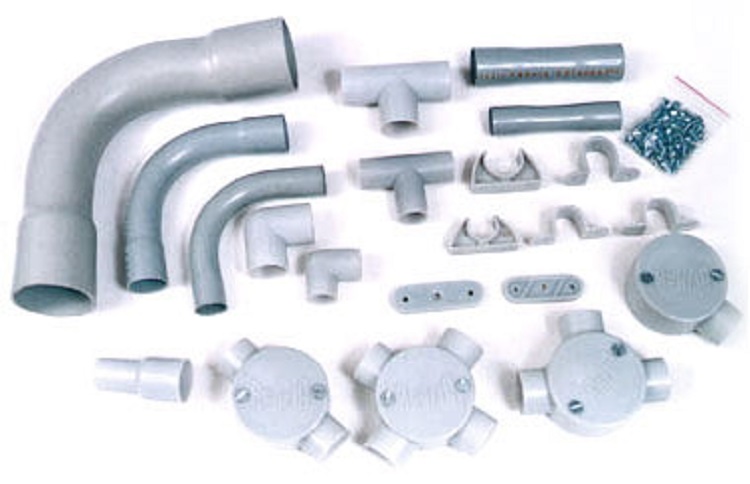
Material found not suitable for site use will be removed from site immediately.
Conduits shall be properly supported and stacked on a flat surface.
PVC and GI Conduits shall be protected from sunlight and moisture by covering them with tarpaulin.
Conduit fittings shall be stacked properly in neat and orderly manner.
Pre Installation Requirements
All materials and documentation relevant to this particular section of works will be checked by the Construction Department prior to the commencement of electrical conduit installation works.
Before starting the conduit laying work make sure that all materials are inspected and approved by the consultant.
Access/egress to the work area shall be confirmed by the main contractor.
Obtain the clearance to start the electrical conduit installation work from client/consultant/contractor as applicable.
Conduit Installation Procedure
Conduit Installation – Cast in situ
Measure and mark-up shuttering for the position of the boxes.
Fix the boxes on their designated locations, ensure that the Boxes are filled with polystyrene to prevent cement sediment to accumulate inside the boxes.
First layer of reinforcing bar to be installed.
For installing the in situ conduits as per requirements, tie the conduits into the reinforcing bars.
Ensure that the maximum run of conduits between two boxes shall not contain more than three (3) quarter bends.
Make sure that the maximum run of conduit between boxes shall not exceed 25m for straight runs.
In any case that the straight run of conduit will exceed 25m, pull boxes shall be installed in between.
Wherever necessary, nylon rope shall be pulled into the conduit run for future purposes, leave a slack of 300mm minimum at each end of conduit.
After installation of conduits, the second layer of reinforcing bar installation will proceed.
Make sure that installed conduits are not damaged during the second layer of the reinforcement.
Raise Request for inspection of conduit installation.
Shutter closing and concreting will commence after the approval.
Installation of Embedded Conduits on Walls
Mark the position of boxes and conduits on the walls.
Chase the wall using appropriate tools i.e., electric concrete cutter and chisel.
Fix the boxes on their final positions, make sure that the boxes are properly protected with polystyrene to prevent entry of foreign materials.
Install embedded conduits.
Raise Request for Inspection of Conduit Installation.
After the works has been inspected, plastering of walls will commence.
Surface Mounted Conduit Installation
Establish the conduit route and mark using chalk liner on ceiling or walls.
Mark the position of the boxes.
Install the boxes on their proper locations.
Install saddle clamp base.
For non-metallic conduits, spacing between saddle clamps will not exceed 1 meter, and for metallic conduit, spacing between saddle clamps will not exceed 1.5 meter.
Install the conduit runs.
Make sure that the conduit runs will not contain three (3) quarter bend.
Where the conduit runs will cross expansion joint, expansion coupling will be used.
Ensure that the spacing between parallel runs of conduit is uniform throughout the installation.
Raise Request for Inspection of GI or PVC conduit installation.
Underground Electrical Duct Installation
Mark the route of the underground duct.
Excavate the underground duct route until the required depth.
Check the depth of the trench for proper elevation. Ensure that the trench is free from debris and foreign materials.
Install the electrical PVC duct.
Raise Request for Inspection of PVC duct Installation.
After inspection is carried out and the said works has been signed-off by the consultant, back fill the trench with approved back filling material.
Install Warning Tapes 300mm below the finish grade.
Raise Request for Inspection for Warning Tape Installation.
After inspection is carried out and the works has been signed off, back fill the trench until the finish grade.
Ensure that the back fill material is properly compacted.
GENERAL INSTALLATION PROCEDURE FOR PVC CONDUITS
- Ensure that the work area is ready and safe to start the installation of electrical conduits
- Prior to start the installation, refer the approved shop drawings related to the area of installation and ensure required material is available at site as per approved material submittals.
- Mark the location of the back boxes or pull boxes & place thermo coal secured with masking tape on these locations.
- Install the PVC conduits utilizing the steel reinforcements as supports by using necessary binding wires.
- The concealed conduiting of slab or any other concrete structure should be securely fastened with binding wires to reinforcement rods or shuttering to withstand concrete & screed pour.
- The jointing of PVC conduits shall be done with suitable couplers and solvent cement. The PVC conduits shall be bonded tightly to the back boxes / pull boxes with suitable adapters.
- The jointing process of PVC conduit will be followed as mentioned below :
- (a) Both the joining ends of conduits will be cleaned from inside as well as from outside by using solvent cleaning fluid and wipe it with clean rag to make it dry.
- (b) A thin layer of solvent cement is applied to the inner surface of the coupler.
- (c) Push fit the conduit ends fully into the coupler by slight twisting action & remove the spilled or surplus solvent cement from around the joint. Make sure the conduit has entered fully into the box spouts and couplers except expansion couplers.
- (d) Make sure that the joint is tight enough and entry of water into the conduit through joints is not possible.
- (e) Approved connectors / adopters will be used for connections to back boxes / pull boxes.
- (f) Expansion couplers of approved type shall be provided wherever the conduits passes through the expansion joints of the building.
- All bends of PVC conduiting will be made by using correct size of bending spring. Ensure the radius of any conduit bend shall not be less than four times the outside diameter of the conduit to satisfy the easy cabling / wire pulling requirements.
- To facilitate easy cabling / wiring sufficient pull box or junction boxes will be provided in all conduiting. At least one pull box shall be provided on every two 90 degree bends.
- In longitudinal straight runs the pull boxes / junction boxes will be provided in every 30 meters.
- Close bunch of PVC conduits in slab shall be avoided to maximum possible extent.
- Sufficient gap shall be provided between conduits at cross-over locations.
- Ensure all open end of the conduit are capped / plugged properly before concrete pouring. Also ensure caps are provided for unused knock out holes where blanks have been removed.
- In vertical wall the conduits shall run vertically from the back boxes. Horizontal runs shall be avoided on walls.
- Ensure the recessed position of outlet boxes is accurate to allow for surface finish thickness.
- Conduits chased into wall should be recessed sufficiently to permit a minimum thickness of 15mm for plaster cover. For conduits run to be embedded in concrete a minimum 25mm cover will be provided.
- After completion of conduiting installation for any portion, the area will be cleaned properly by removing all surplus material, construction debris or scrap material etc., to leave the are in clean and tidy condition prior to concrete pour.
- After removal of concrete shuttering, all the conduits shall be checked for blockage (wherever possible), shall be cleaned & plugged/covered.
Reference Documents
Electrical Shop Drawings
Material Submittals for Conduits and Boxes
Material Inspection Report
Project Health & Safety Plan
Project Quality Plan
Discover more from Project Management 123
Subscribe to get the latest posts sent to your email.